Interactive module ads

Role
Product Designer
Cross-functional partners
UX researchers, sales, product management, ads design team
Timeline
4 weeks (June 2021)
Skills
UX research, ideation, pitching to stakeholders, wireframing, prototyping for proof of concept
Tools
Figma, Principle

The ad formats team was kicking off their product vision project that would push Twitter to be bolder, create excitement and drive clarity on what the future of ad formats on Twitter should look like.

As the solo designer, in collaboration with our cross-functional teams, I explored a breadth of new and unique interactive experiences with our ad formats. These interactive ad formats would serve the particular needs of several different user groups on Twitter.

the opportunity

Twitter has become the top social media platform where people go to during live events, big announcements and the latest news. Twitter is uniquely positioned to drive engagement right when it happens.

+ 160%
lift in unique authors during 2019 Game awards
3.4x
lift in unique authors during Nintendo Direct 2019
+ 167%
lift in unique authors during the Fortnight blackout
Customer needs

People come to Twitter with a discovery mindset, and want to stay informed about the products and events they’re interested in.

Advertiser needs

Advertisers are looking to create excitement around their product launches and drive customers to take action.

The Solution

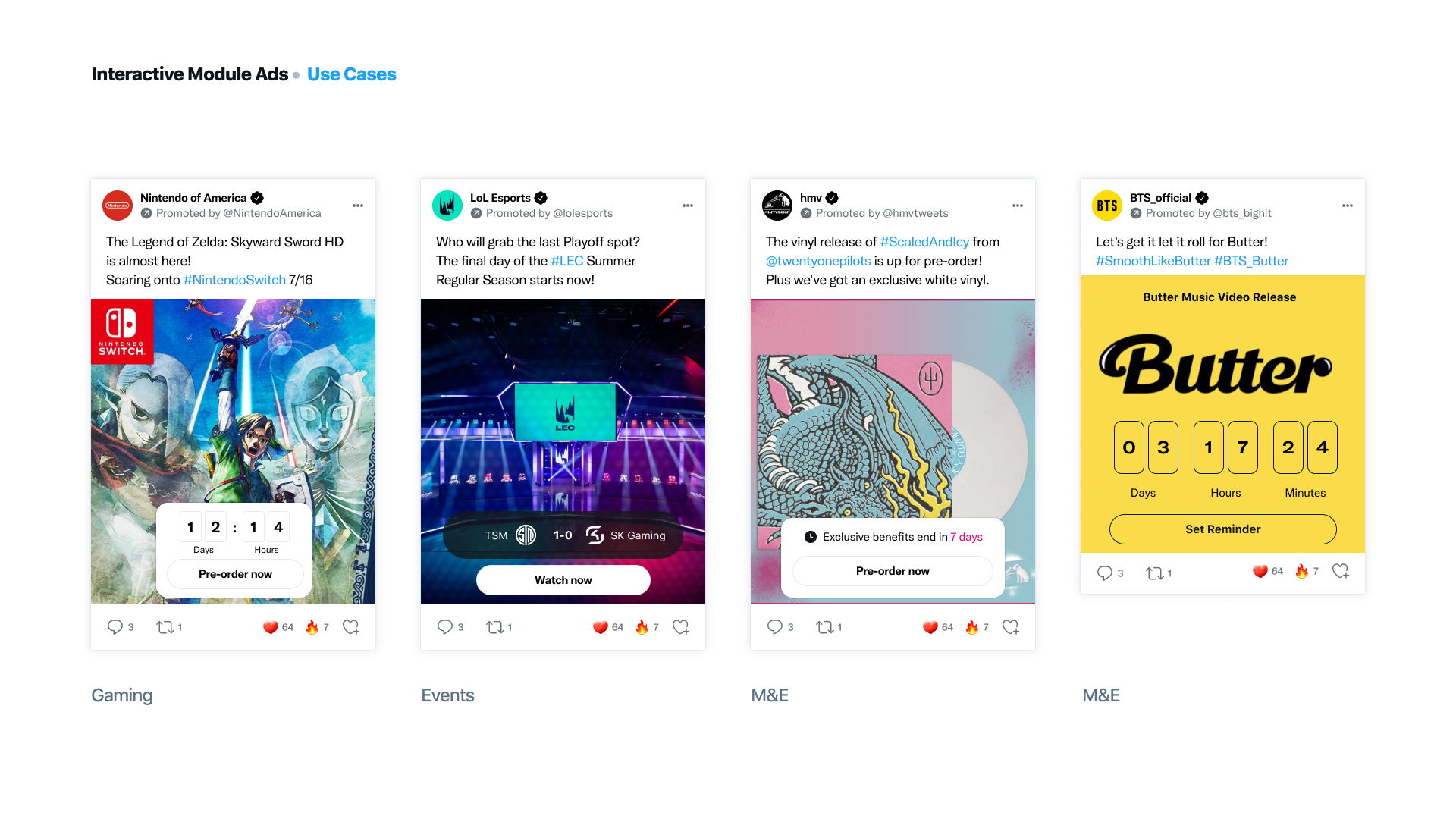
Countdown module ad to create anticipation and drive action

Hypothesis 
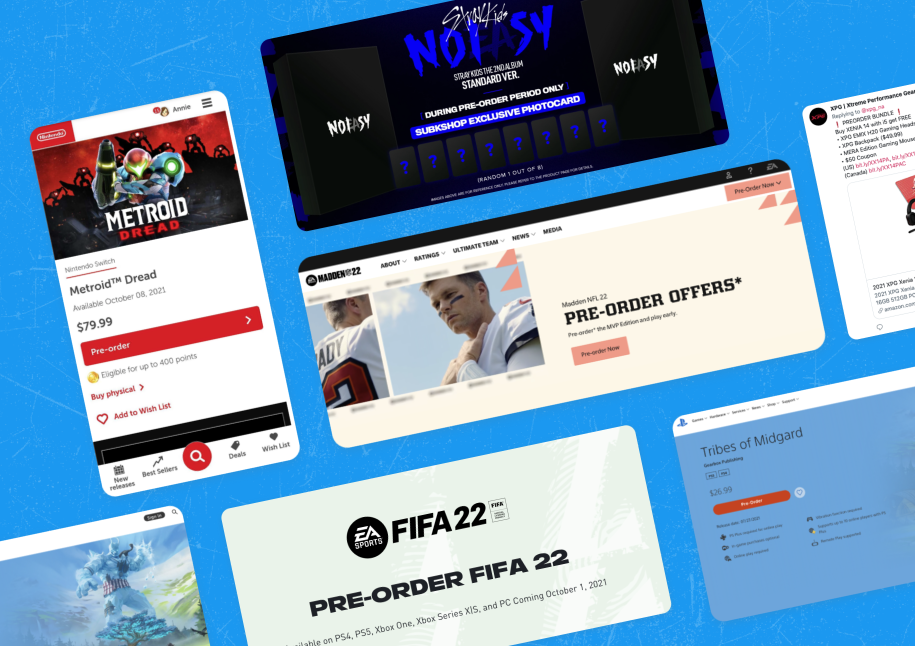
Modules for pre-ordering will allow users to benefit from time-sensitive launches and advertisers to drive results "right as it happens" to generate excitement and interest.
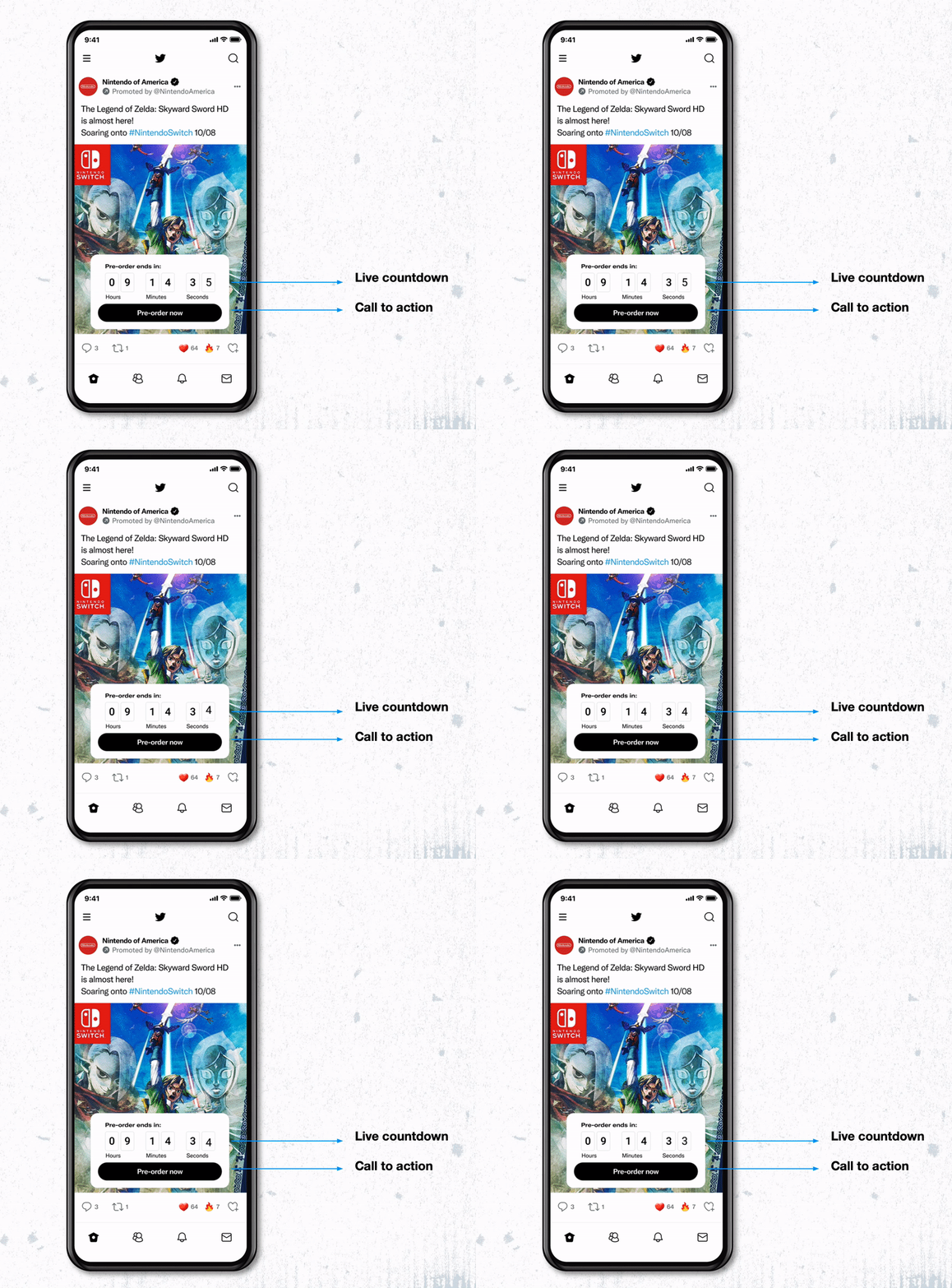
Live countdown and a clear call to action to drive engagement.

Most advertisements will run for days not just hours. The dymanic countdown will change accordingly depending on how much time is left for pre-order or presale.
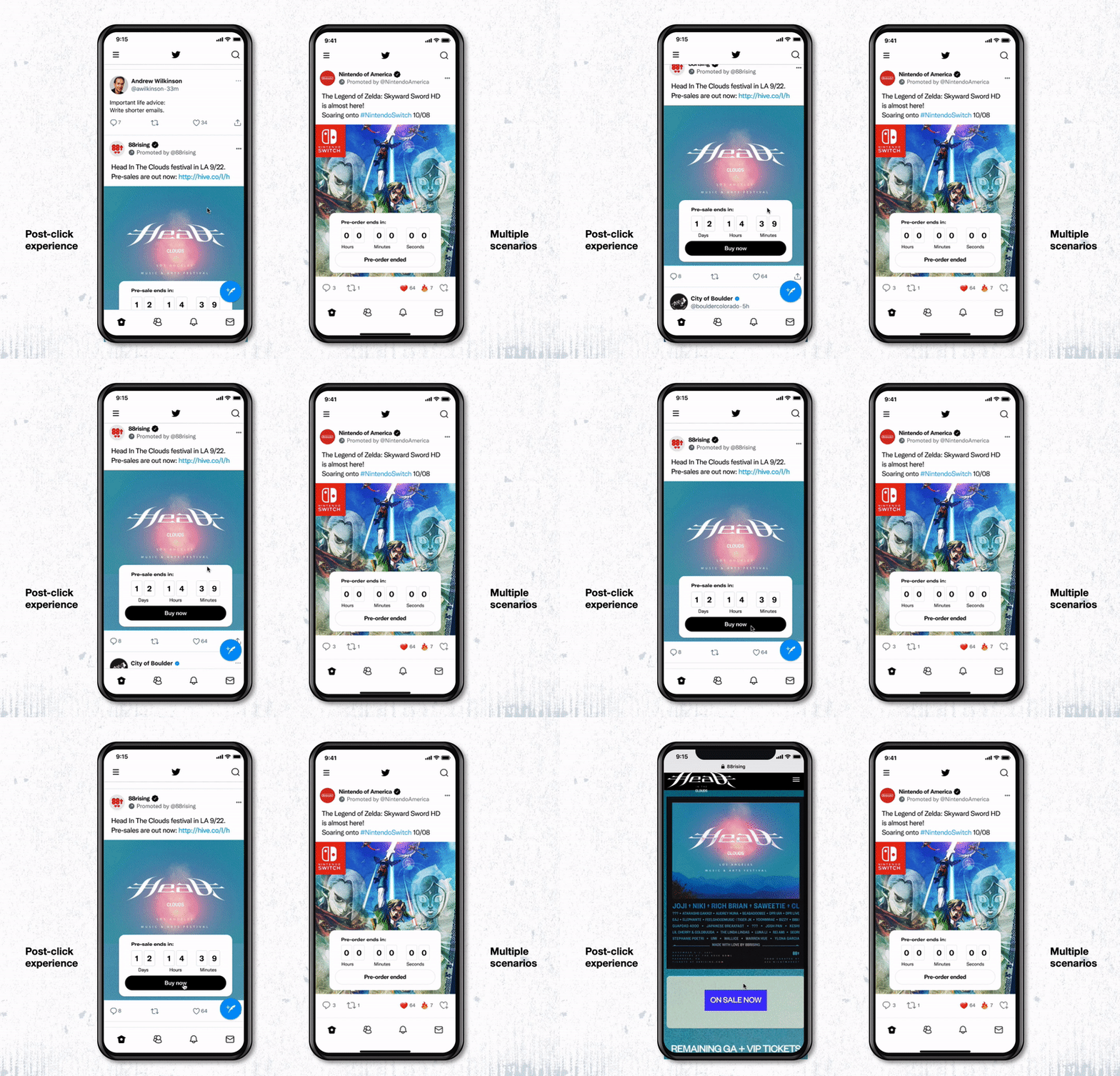
Uses familiar patterns, such as the post-click experience on Twitter.

To accommodate the fact that ads sometimes run longer than the end date, a pre-order ended is still available to drive product awareness.
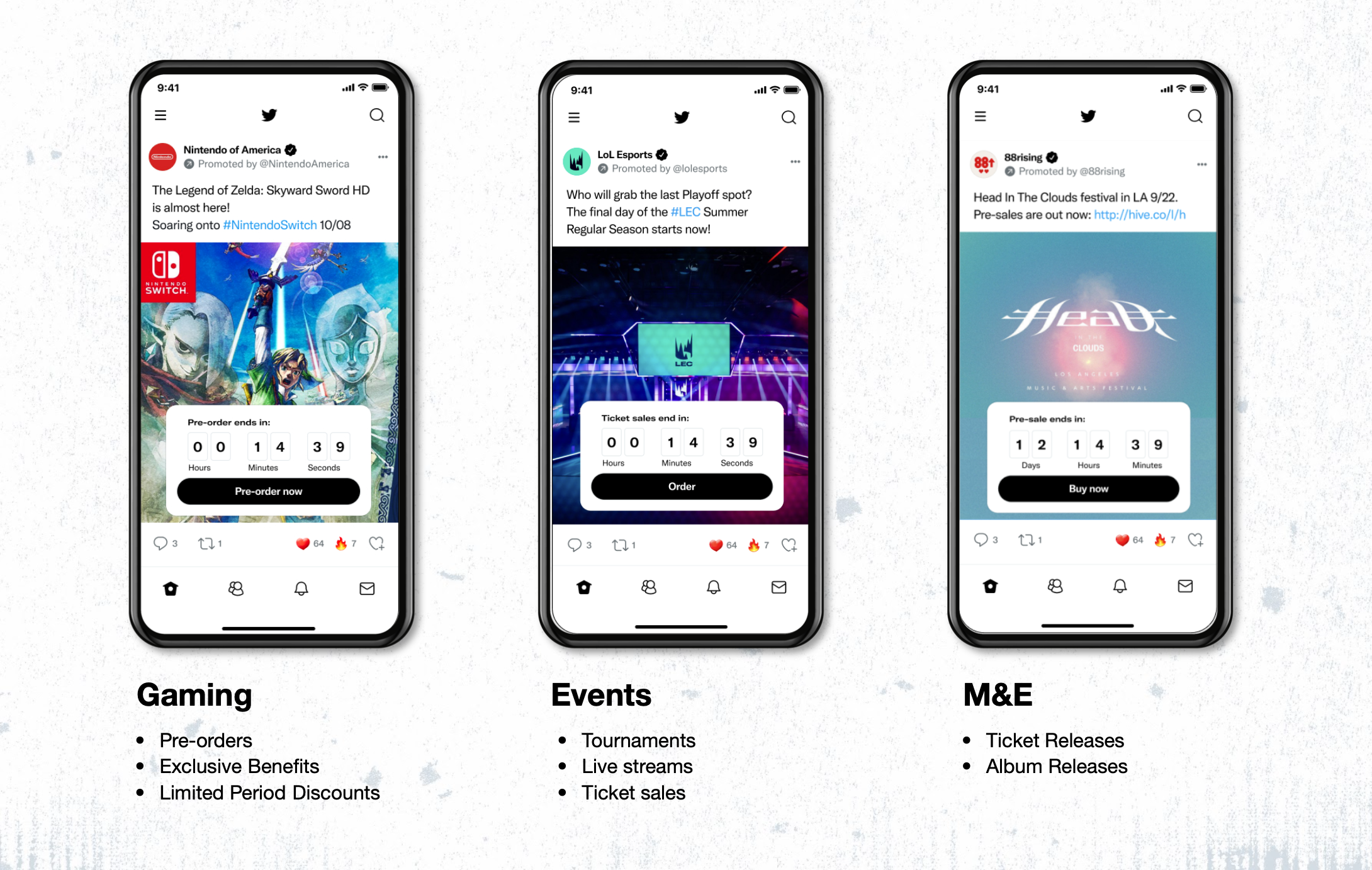
Scalable to game releases, events, and entertainment releases.

I learned that every feature needs to not just be designed intentionally, but keeping in mind flexibility and scalability on a live platform.
the process

Project goals

1.
Research

Audit and research the user and business needs of specific markets across the marketing funnel and product life-cycles

2.
Evaluate

Evaluate the expected user and customer impact of the new interactive ad formats

3.
Identify

Identify areas of convergence and create flexible modules that can adapt to bigger customer needs

qualitative research

The "Jobs-to-be-done" of our advertisers

Unlike my previous experience at a small startup, due to the structure of Twitter, I quickly learned that it would be difficult to directly talk to our users. Despite this, I learned to proactively reach out, ask questions and be resourceful. I was able to create a foundation on past research and have chats with people in sales and UX research who would have first-hand interactions with our users and advertisers.

Drive engagement
Capture people’s attention and make a splash
Educate
Teach people about a product and tell a story
Resonate
Connect with people and make an impact on them emotionally
Evangelize
Get people to share or talk about a product
Drive Action
Encourage people to take deeper marketing funnel actions (purchase, conversions)

Balancing user needs vs. advertiser needs

A dilemma when working in the ad space is balancing the needs of both the users and the advertisers, which may come into conflict. Users usually feel more positive sentiments towards ads from brands they have experience with or match their interests. The overarching goal is to connect a brand with users and a way for users to get value out of topics they actually care about.

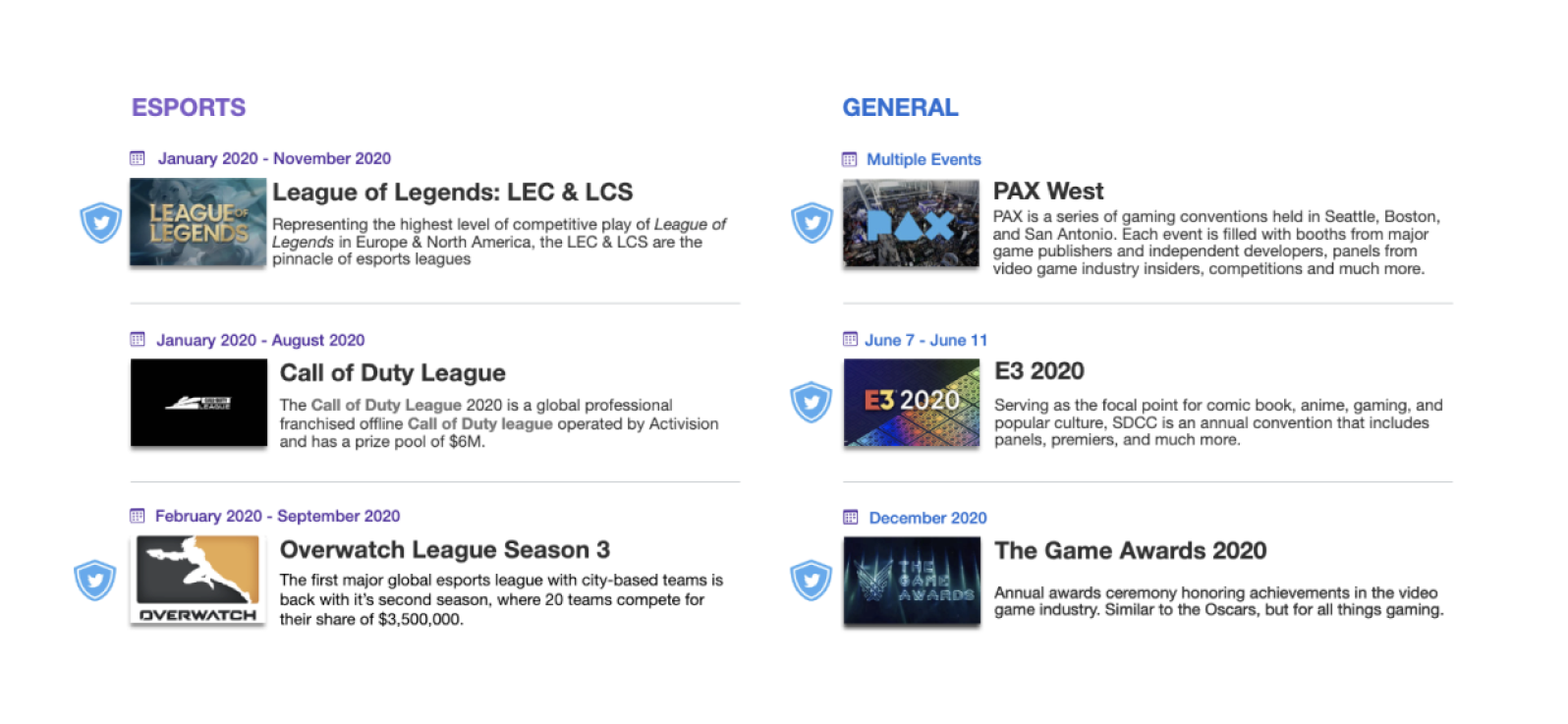
In the ideation phase, I decided to focus my research on two of our fasted and active communities on twitter: Gaming and Media & Entertainment.

Insights
Gaming

• Twitter is more likely to be used in the moment while watching esports/gaming content
• Product timeline includes reveal to launch and the conversation on Twitter is "always-on"

Media & Entertainment

• Users engage with announcements and in-the-moment live tweeting
• Advertisers have the goal to drive conversion as early as possible, with a sense of urgency once a product is released. ie. ticket sales, events, etc.

When researching these two industries, I noticed how many of their initiatives were time-sensitive. I wondered, was there a way for users to benefit more from these types of content and for our advertisers to drive more interest?

Explorations

Using our design system, Feather, I was able to ideate and create mockups. Since this type of project required pitching the idea to leadership and product managers, it was best to go into specific use cases and higher fidelity mockups to paint a better picture of the feature.

Feedback from the team helped to identity areas of similar user needs to define the design, such as:

• How would one single module scale for different use cases?
• What happens when the launch happens? After the launch? How does it change?
• How can we make it more clear what the time stand for?
• Is there enough affordance? How can we make the CTA appear more tappable?
• Will this design work for different languages?

Advertiser and consumer research

Validating feasibility with users

Our research team conducted one hour in-depth interviews among both advertising decision-makers and consumers who use Twitter at least three times per week. An early version of the countdown module was among the twelve new prototypes that gathered feedback.

Internal research report blurred for NDA.
“Often people intend to purchase but once they leave Twitter, they forget...so this would get them to convert to customers right then...It will be a game changer.” - M&E Advertiser, Japan
improvements and considerations

Clearer CTA - Provided reccommded CTA for the advertiser when creating the ad.
Module needs to be scalable - Changed spacing to allow space for multiple languages

Next steps

Given more time, I would have liked to do usability tests on the finalized concepts and get feedback from advertisers. I would also want to work more on:

Measuring success - If this concept were to be tested, we should look into how many views convert to engagement on the advertisements.

Pre-order periods - Some pre-order periods last weeks, which would be harder to create anticipation for with lots of time remaining.

Learnings

As a designer it is important to learn your users mental model so you can intentionally make decisions about when to adapt the design to user expectations and when to take extra pains to education the user on deviations. While being on the ad formats team we become familiar with the intent of the design and the requirements, users will be seeing these for the first time and it is important to keep that human-centric and empathetic mindset.

Clear documentation and being in sync with your cross-functional partners are key! When you leave room for interpretation, your designs probably won't be given the feedback it is needed or be engineered to spec.

This comes hand-in-hand when communicating new ideas, be sure to have the testing done and ready to be brought up to provide reasoning and intention to your solution.